




Legal realism liberates where legal fiction enslaves
Valérie Bugault, 24 March 2026
My dear friends who follow Révoludroit, the time has come to explain that we are confronted, through the contemporary movement advocating the personification of nature for the purposes of tokenization, with an attempt to appropriate living reality on a scale unprecedented in human history.
In order to understand what is at stake, I invite you to read the following article, written by a man whom I know personally, which clearly explains the link between the personification of nature and tokenization: https://www.planetevagabonde.com/post/guerre-en-iran-le-pr%C3%A9texte-id%C3%A9al-pour-changer-le-syst%C3%A8me-financier-mondial
The only effective way to counter this attempt at total enslavement is to adopt radical legal measures rooted in the Continental legal tradition and in Thomistic distinctions. By doing so, we would restore legal certainty and the fundamental traditional distinction between rights in rem and rights in personam—a distinction which, by its very nature, prohibits the appropriation of one human being by another, which is precisely the definition of slavery.
The only renunciation required by such measures concerns the appropriation of the soil itself. Ownership of buildings and constructions would remain possible, but ownership of land as such would disappear, since the soil would, by its very nature, become an element not susceptible of appropriation.
Subsequently, it would of course be necessary to develop new legal provisions governing the management of natural elements, with the sole objective of serving the general interest. Such details will have to be addressed in due course.
It is essential to understand that the movements advocating the “personification of nature” and the “reification of living beings” ultimately belong to the same struggle led by acquisitive powers seeking absolute control over everything.
Let us return to fundamentals: the mission of law is to organize life in society—our life in common. To achieve this purpose, law must be grounded in reality and must refrain from creating legal fictions, which ultimately constitute an abuse of law.
Several practical examples illustrate such legal fictions:
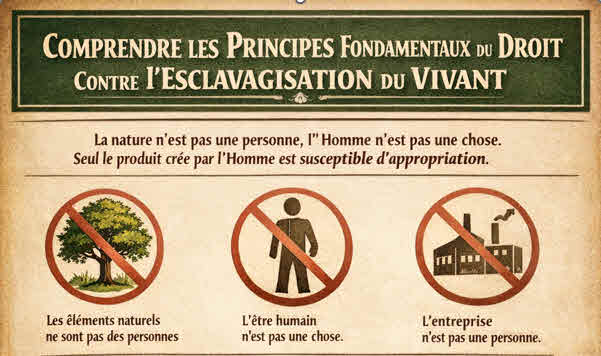
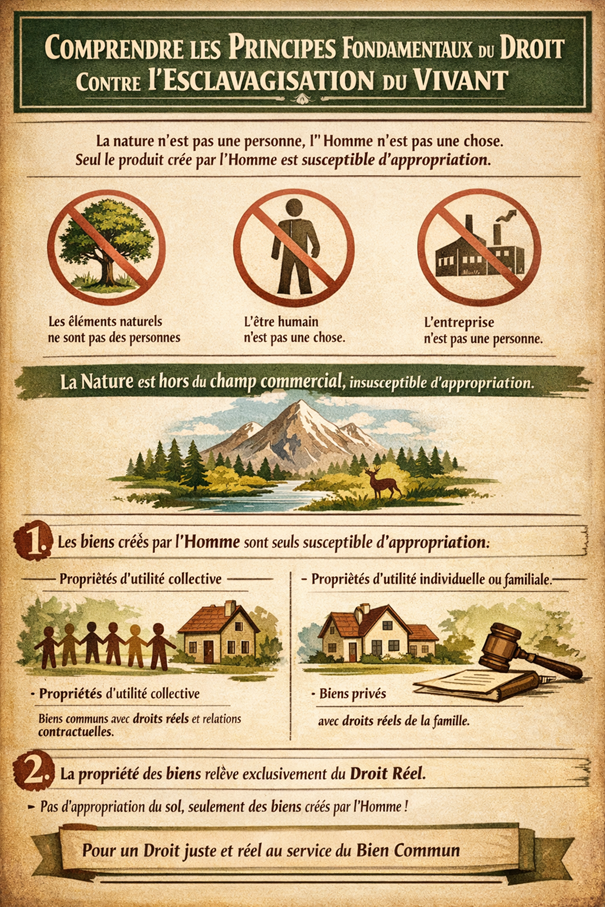
- Natural elements are fundamentally different from human persons. Attributing legal personality to natural elements constitutes a legal fiction.
- A human person is not a thing. Treating a human being as a thing—or reifying the human person—constitutes a legal fiction.
- The animal and plant worlds organize themselves according to their own internal orders. Attributing legal personality to the animal or plant realms constitutes a legal fiction.
- A business enterprise is, by its very nature, a form of social organization. The legal personification of the enterprise—something we have long taken for granted—constitutes a legal fiction.
- Living beings—that is to say animals and plants—possess a living nature but are not human beings. They must therefore be protected according to their own nature, but they must not be assimilated to human persons, since their essence is fundamentally different. The manner in which animals and plants organize and regulate their existence within their environment differs fundamentally from the way in which human beings organize their own.
It is both necessary and sufficient that the law respect the proper nature of each element composing the earth and of every living being for humanity to live in harmony rather than in opposition or in a mode of predation.
Within this framework, several principles must be clearly established.
I. Nature Outside the Sphere of Commerce
Nature, by its very nature, lies outside the sphere of commerce and is not susceptible of appropriation. It may, however, be administered by human beings exclusively with a view to the general interest.
Only products manufactured by human beings fall, by their nature, within the sphere of commerce and are therefore susceptible of appropriation.
II. Property and Goods Created by Human
Beings Only goods created by human beings are, by their nature, capable of appropriation.
The ownership of goods falls exclusively within the domain of rights in rem. Such goods may in turn be distinguished according to whether they serve a collective utility or an individual and/or familial utility.
A. Collective Property
Certain goods serving a collective utility constitute collective property.
Each co-owner holds a real right in the thing itself, while the relations between co-owners are governed by contract law, which gives effect to personal rights (rights in personam).
B. Individual or Familial
Property Other goods created by human beings may be appropriated solely according to the model of rights in rem.
The relations between the various members of a family—which give rise to personal rights—fall within the scope of family property law.
Valérie Bugault is a legal and political analyst specializing in institutional reform and sovereignty issues. Through the Révoludroit project, she explores new frameworks for political and legal renewal.