


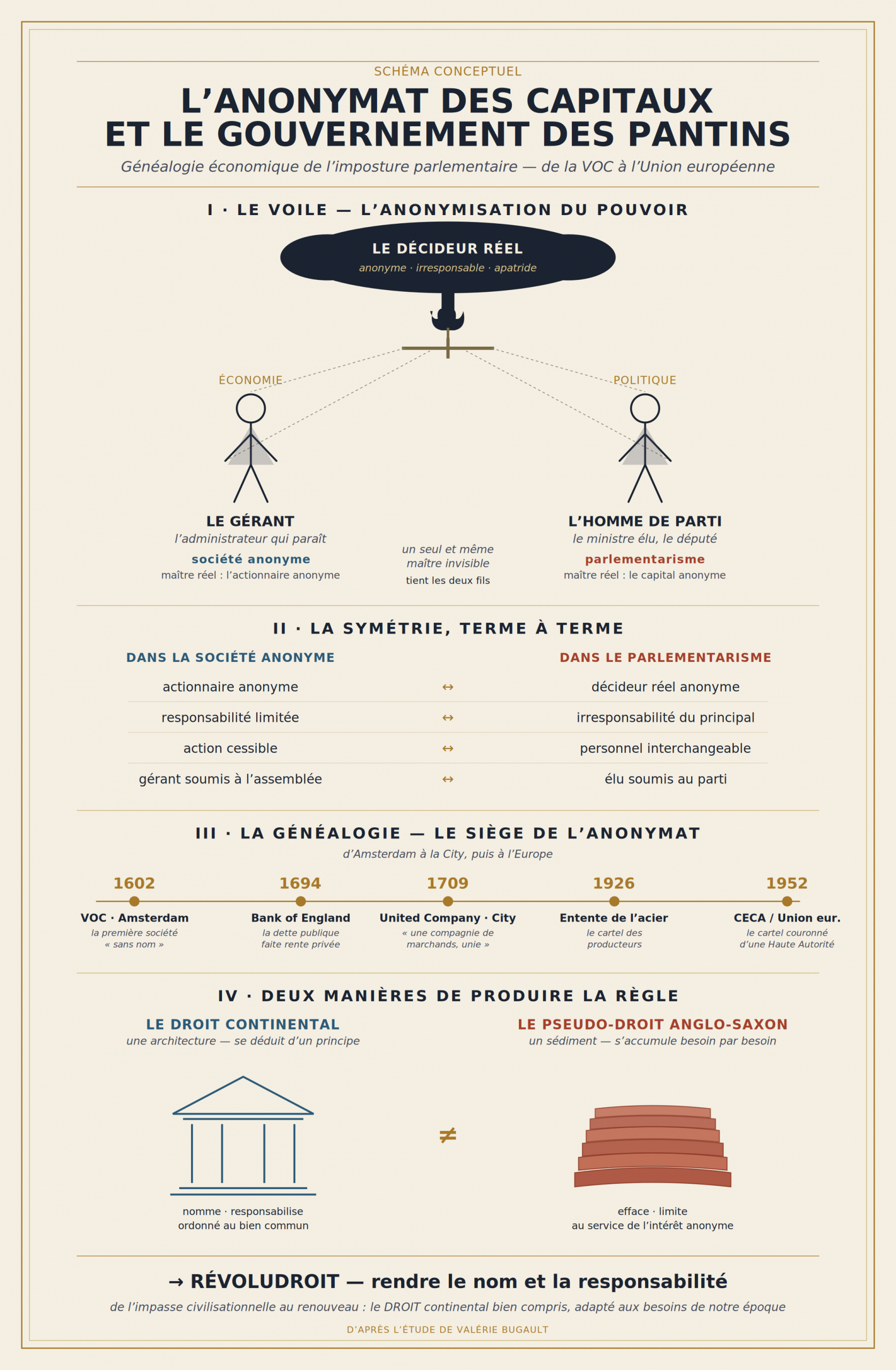


From the Dutch Company to the British East India Company: an economic genealogy of the parliamentary imposture, and a comparison with continental LAW
Preliminary: what the present study adds to the preceding one
The Separation of Powers: Genealogy of an Imposture established three things: that the regime called “separation of powers” is, in France, a British import; that the philosophy of law which made it thinkable—nominalism, utilitarianism, positivism—came from England, Germany, and Vienna; and that the result, grafted onto the French centralizing apparatus, delivered the most concentrated instrument in Europe into the hands of particular interests whose pretensions it was originally meant to hold in check. Two institutions were there identified as the principal components of the imported device: Parliament, the organ of the propertied, and the central bank, the private appropriation of a sovereign prerogative.
The present study takes up the demonstration where it left off, and seeks its economic root. For one question remains that the preceding study did not settle: whence do they both proceed, the Parliament of the propertied and the private monopoly bank? The answer lies in a single, matricial legal invention, of which they are but two applications: the société anonyme—the anonymity of capital. We shall establish that this invention arose from the needs of the great transatlantic monopoly companies; that it migrated from Amsterdam to London at the very moment when Cromwell there gave shelter to the stateless finance of the United Provinces; and that parliamentarism is nothing other than the political transposition of the same technique: a device of anonymization that conceals the real decision-maker behind a visible puppet.
Three propositions will be established. First proposition. The société anonyme is not one commercial form among others: it is the decisive legal mutation of modern capitalism, the one that separates the visible master from the invisible owner. Second proposition. This technique was forged by the Dutch East India Company (1602), transferred to London under Cromwell, then consummated by the “Glorious Revolution” of 1688, brought to its perfection by the British East India Company and the City—and taken up again, in the twentieth century, by the European Union, a cartel of producers united across the nations. Third proposition, and it is the least perceived. Parliamentarism is the constitutional form of the anonymity of capital: it produces apparent decision-makers—the men of party—to cover real decision-makers whom no ballot names and whom no responsibility reaches. What is called Anglo-Saxon “law” is, from that point on, merely the sediment of the successive needs of the Company—the exact contrary of a LAW.
PART ONE — THE MATRICIAL INVENTION: THE SOCIÉTÉ ANONYME
I. 1602: the first company “without a name”
The Vereenigde Oost-Indische Compagnie—the Dutch East India Company, or VOC—was constituted at Amsterdam in 1602. Economic historians agree upon its status: the first limited-liability joint-stock company in history, endowed with freely transferable shares, negotiable on a secondary market—the Amsterdam Exchange, created the same year to receive them.
The name that the Dutch language gave to this form says everything, and it warrants a pause. It is called naamloze vennootschap: literally, company without a name, an anonymous company. French retained the same word—the société anonyme of the Commercial Code of 1807. Anonymity is therefore not an accident of the thing, nor an abuse committed by its adversaries: it is inscribed in its original designation. What the form conceals, it proclaims in its name. The owner does not appear there; only the security appears.
II. The double property of anonymous capital: invisibility and statelessness
One must describe exactly what this form confers, for therein lies the heart of the system. The société anonyme endows capital with two attributes that no named fortune had ever brought together, and which render it, both alike, beyond the sovereign’s grasp.
The first attribute is invisibility. Between the power of decision and the person who exercises it, the société anonyme interposes a screen: the share. The director who appears—the governor of the Company, the administrator, the director—is not the master; he is the revocable mandatary of shareholders whom nothing obliges to name themselves. The real master stands behind the security, and the security does not speak. For the first time, economic power can be exercised without the one who holds it being known, and hence without his being held to account.
The second attribute is statelessness. The share is mobile: it passes from hand to hand, crosses frontiers, lodges wherever it wishes. The capital thus formed no longer has any soil. It belongs to no territory, owes fidelity to no crown, is subject to no law that it cannot leave by changing its place. It is stateless capital in the proper sense: without homeland, because without body and without name. The United Provinces were themselves not a kingdom but a merchant republic, in which the Company was quasi-sovereign—army, coinage, treaties, war. The finance that had formed there had no prince: it was its own prince.
One recognizes here, transposed into the economic order, the mutation that the preceding study described in the philosophical order. The anonymous share is the subjective right in its pure state: a power of the subject detached from any just thing, from any objective order, from any end exterior to itself. Where continental LAW attaches property to a named person and to a responsibility, the société anonyme dissolves the person into the security and the responsibility into limitation. Legal nominalism and the anonymity of capital are two sides of a single refusal: the refusal to name the real and to answer for it.
III. A form dictated by the “needs” of the Company
This form was not born of a principle; it was born of a need. The great transatlantic monopoly company had four necessities, and the société anonyme answers them one by one, term by term.
It had to assemble mass capital that no private fortune could supply alone: the divisible and transferable share aggregates it. It had to endure beyond lifetimes and beyond expeditions: permanent capital gives it perpetuity. It had to dilute the risk of ventures in which everything could be lost—shipwreck, piracy, war: limited liability shields the shareholder’s patrimony. It had, finally, to withdraw the masters from view—from creditors, from rivals, from the prince: anonymity effaces them.
Let us retain the method, for it is the key to all that follows. Law there does not precede the need; it follows it. The legal form is fashioned to measure, like a tool upon the workpiece. This mode of producing law—the need first, the rule afterward—is the exact opposite of continental LAW, in which the rule is deduced from a principle prior to needs and is imposed upon them. We shall see (Part Five) that this opposition of method governs all the rest.
PART TWO — THE TRANSLATION: FROM AMSTERDAM TO LONDON
IV. The birth of the Amsterdam market: the meeting of two displaced finances
Before passing to London, the technique had to be born somewhere. It was born at Amsterdam, at the turn of the seventeenth century, and it was born of a meeting. The young merchant republic of the United Provinces gathered, on the Atlantic seaboard, two financial traditions that history had just uprooted—and it is from their confluence that the first société anonyme emerged.
The first current came from the Iberian peninsula. The expulsion decree of 1492 had driven out of Spain the Jewish bankers who held a large share of peninsular finance and trade. A century of exile—through Portugal, then through Antwerp—led many of them toward the United Provinces, a republic in revolt against the crown of Spain, where no prince pursued them and where commerce was free. They brought there a technique, networks, and capital: a finance already uprooted, already accustomed to possessing nothing that could not be transported.
The second current came from Italy. The bankers of Genoa, Venice, and Florence had held, for three centuries, the monopoly of Mediterranean commerce and of the finance of Christendom. But the ground was giving way beneath them: as great commerce passed from the Mediterranean to the Atlantic—after the opening of the new routes, and it is no accident that Columbus was Genoese—the primacy of the Italian cities was crumbling. Genoese finance itself shifted toward the Iberian peninsula and the Atlantic world, into banking, sugar, and the slave trade. The masters of the old sea were losing their monopoly to the new ocean.
These two displaced finances—one driven out by an edict, the other by the displacement of commerce—meet where the future is heading: on the Atlantic seaboard of the United Provinces, in a republic without a king, freed from every prince. And it is there that they invent the instruments the sequel describes: the société anonyme (1602) and the Exchange that receives its shares. One must measure the significance of this. The anonymity of capital was not invented by an established and rooted finance: it was invented by a finance that had already lost its soil—twice over—and that made a form out of its uprooting. The société anonyme is the legal crystallization of statelessness: of a capital that has learned to owe nothing to any land, because it has twice been driven from it.
V. Cromwell and the reception of the finance of the United Provinces
The technique was Dutch. It became English. The moment of this transfer can be dated, and it bears a name: Cromwell.
The rivalry with the United Provinces is at first frontal: the Navigation Act of October 1651 aims directly at Dutch commerce, and the First Anglo-Dutch War follows at once. But Cromwell understood that one does not defeat Amsterdam by combating it alone: one defeats it by attracting it. In December 1655, he convened the Whitehall Conference to rule on the return to London of the merchants of Amsterdam—that is to say, in fact, of that displaced financial center described above, the most skilled in Europe in the techniques of the share, the bill of exchange, and the market. The conference produced no text: Cromwell broke it off before an unfavorable opinion could form. But the readmission took place de facto in 1656; a first synagogue opened in London in 1657. No solemn act: an open door, without law, for a finance without homeland.
There is here no need for any hypothesis about persons, and honesty commands that we hold to the structure. What passes then from Amsterdam to London is not first of all a group: it is a savoir-faire and a mobile capital—precisely the stateless finance described above, the finance that has no crown because it is made of anonymous and transferable securities. Cromwell saw in the settling in London of the rich merchants of Amsterdam the means of strengthening English commercial power against the United Provinces. He did not bring men: he brought a model. And that model is that of the VOC.
VI. 1688: the “Glorious Revolution” as financial revolution
The transfer is consummated a generation later. In 1688, William of Orange—stadtholder of the United Provinces—takes the throne of England. He brings not merely a dynasty: he brings the entire Dutch financial apparatus. Historians designate the period by a name that has become classic, the Financial Revolution—the English financial revolution—whose standard description was given by P. G. M. Dickson. Three Dutch techniques are there acclimatized within a few years: transferable shares negotiated on a secondary market; perpetual annuities on the State; and the bill of exchange as a negotiable instrument.
The dates follow one another with a clarity that dispenses with commentary. 1693: first long-term public loans. 1694: foundation of the Bank of England—that private joint-stock company whose mechanism the preceding study described, and which is nothing other than a naamloze vennootschap applied to the debt of the realm. The creation of money, a sovereign prerogative, thus passes under the screen of the anonymity of capital: the central bank is the société anonyme made monetary sovereign. Amsterdam furnished the method; London becomes its seat. The City receives what the Amsterdam Exchange had invented, and carries it to a degree of power that the United Provinces had not attained.
The displacement summed up in the formula—from the VOC (Amsterdam) to the BEIC (City of London)—is therefore not an image: it is a dated fact. The seat of the anonymity of capital is transported, between 1655 and 1694, from the United Provinces to the Kingdom of England, and it will never leave it again.
PART THREE — THE NEEDS OF THE COMPANY AND THE FABRICATION OF A “LAW” MADE TO MEASURE
VII. The British East India Company, model organism
The British East India Company—the BEIC—received its royal charter on 31 December 1600, from the hands of Elizabeth I, with the exclusive monopoly of trade east of the Cape of Good Hope. A joint-stock company with capital at first temporary, then permanent, it merged in 1709 with its rival under a name that deserves to be read—The United Company of Merchants of England trading to the East Indies. A company of merchants, united, holding a monopoly, endowed with armies, fleets, and territories: such is the organism whose needs will shape, piece by piece, what will come to be called English “law.”
The confounding of the Company and the State need not be inferred: contemporaries themselves feared that the enriched servants of the Company and their agents would “corrupt Parliament by forming there an invincible Indian interest.” The Company does not merely weigh upon the assembly of the propertied: it sits within it. The assembly of landed proprietors born at Runnymede in 1215—which the preceding study recalled to be the birth certificate of the parliamentary regime—now receives, within its bosom, the assembly of the owners of shares. Parliament and the Company are two chambers of the same interest.
VIII. The cartel of united merchants: from the East India Company to the European Union
The formula that closes the description of the Company—a company of merchants, united—describes not only the organism of 1709. It describes, at three centuries’ remove, the manner in which contemporary Europe was constituted. The proposition deserves to be established with the same rigor as the preceding ones, for it extends the genealogy down to our own day.
The European Union was born neither of a people nor of a principle: it was born of an industrial pool. The Schuman Declaration of 9 May 1950, conceived and led by Jean Monnet—Commissioner-General for Planning, then first president of the governing organ—proposes to “pool” the coal and steel of France and Germany. The Treaty of Paris, signed on 18 April 1951 and entering into force on 23 July 1952, institutes among six States the European Coal and Steel Community: a common market, without customs duties, for the two materials of which heavy industry and armaments are made.
Now these two materials were precisely those that producers’ agreements had organized between the two wars—foremost among them the International Steel Agreement of 1926, which apportioned production quotas among the same Rhenish and Lorraine basins. The continuity is one of structure: the ECSC takes up the domain of the old steel and coal cartels, and raises it higher. Where the cartel was merely a private agreement among producers, the Community confers upon it a supranational public authority. The cartel is not dissolved; it is crowned.
The name of this governing organ must be read as one has read “United Company”: the High Authority. Nine unelected members, presided over by Monnet, endowed with the power of decision over the coal and steel of six nations—that is to say, withdrawing these industries from the sovereignty of States and from the view of peoples. The East India Company had its governor and its court of directors; the Community has its High Authority and its president. Neither the one nor the other answers to an electorate. And the filiation is direct: the High Authority of 1952 became the European Commission, an unelected organ in which the real power of initiative resides, while the elected personnel—national, then European—occupies its visible stage.
One then recognizes, carried to the scale of a continent, the structure described throughout this study. A cartel of merchants—here, of producers—united across the frontiers, governed by an authority that no people has chosen and that no people can undo, and covered over with a name that conceals its nature: no longer “company,” but “community.” The procedure is the one that the preceding study named the vol de nom, the theft of name: one calls “community” what is a producers’ agreement, just as one had called their fusion “separation of powers.” The device itself does not vary: the real decision-makers—the organized industrial and financial interests—stand behind the screen of an anonymous authority, while the elected governments hold, at the front of the stage, the role of the puppets.
A company of merchants, united: the formula holds for the British Company of 1709 as for the Europe of 1952. Three centuries separate the two; the form is identical. The anonymity of capital, born at Amsterdam, consummated in London, found in the European construction its accomplished figure—that of a market withdrawn from the nations and governed by an authority without a name.
IX. The stages of a sedimentary corpus
One can then reconstitute the stages by which the corpus of the Anglo-Saxon pseudo-“law” was constituted. Each answers a determinate need of the Company, and it alone. None is deduced from a principle. The corpus has no architecture: it has a history—that of the solutions brought, one after another, to the successive necessities of the monopoly.
The monopoly charter (1600, 1602). The sovereign sells an exclusive: law becomes a merchant’s privilege, a favor that can be bought. First stage: the rule is a good that one purchases.
The anonymous share and limited liability (VOC 1602, then English company law). The Company needs its masters to be invisible and sheltered: law fabricates the company without a name. Second stage: the rule effaces the owner.
Public debt as private annuity (Bank of England, 1694). Finance needs the revenue of the State to be converted into a perpetual claim: law institutes the private central bank. Third stage: the rule privatizes the sovereign prerogative.
Parliamentary sovereignty without a written Constitution. The Company needs an assembly of the propertied above which there is nothing—no norm, no judge, no principle: law refuses the Constitution. Fourth stage: the rule frees the assembly from the people.
The theory of law as command (Bentham; Austin, 1832: law is the command of the sovereign accompanied by a sanction). The Company needs law to be whatever the will that posits it decides, and therefore infinitely plastic: law defines itself as force. Fifth stage: the rule is no longer the just thing, but the command that constrains.
These five stages obey no common logic save that of need. This is why one must refuse to this ensemble the name of LAW. Law—in the continental sense—is an architecture that is deduced; this corpus is a deposit that accumulates. The common law itself, proceeding case by case, species by species, without a first principle from which the solutions would be drawn, is the exact jurisprudential form of the société anonyme: it advances by particular needs resolved as they arise, never by deduction. Anglo-Saxon pseudo-law is to legal science what the anonymous share is to property: a power without principle and without name.
PART FOUR — PARLIAMENTARISM AS A TECHNIQUE OF ANONYMIZATION: THE GOVERNMENT OF PUPPETS
X. The political transposition of the screen
We reach here the central proposition, the one that links the economic study to the constitutional study. The technique of anonymization invented for capital was transposed to politics. What the share does in the société anonyme, the party does in the parliamentary regime: it interposes an apparent decision-maker between power and its true master.
In the société anonyme, the visible director—the administrator—masks the invisible shareholder. In parliamentarism, the visible man of party—the minister, the deputy, the elected leader—masks the invisible holder of capital. The preceding study showed that the party is a British invention, an organ of ideology, and that it in fact concentrates the three powers in the hands of the same persons. One must now state its ultimate function: the party is the mechanism that fabricates the puppets and makes them dance. It selects interchangeable figures, invests them, disciplines them, revokes them. The election parades the visible personnel; the real decision-makers—anonymous and mobile capital—appear on no ballot and answer to no one. The voter chooses among marionettes; the strings are held offstage.
XI. The symmetry, term by term
The correspondence between the economic form and the political form is not a loose analogy: it is term by term, and this is what makes it conclusive.
To the anonymity of the shareholder corresponds the anonymity of the real master. No one can name the one who decides, neither in the enterprise nor in the State.
To the limited liability of the shareholder corresponds the irresponsibility of the real decision-maker. The minister or the party “falls”—as the administrator is revoked—but the principal remains unharmed, his patrimony and his person beyond reach. One sacrifices the puppet; one never touches the puppeteer.
To the transferability of the share corresponds the interchangeability of the political personnel. One security is worth another; one minister is worth another. The alternation of parties is the circulation of securities applied to men: it changes the bearers, never the property.
To the subordination of the director to the general assembly corresponds the subordination of the elected official to the party. The deputy owes his seat not to the people but to the apparatus that has invested him—just as the administrator owes his post not to the public but to the shareholders. In both cases, the one who appears to serve the multitude answers only to the capital that placed him there.
To the absence of a norm superior to the assembly corresponds the absence of a principle superior to the will that posits the law. The veil of the legal person, which shields the shareholder from the debt, and parliamentary sovereignty without a Constitution, which shields the assembly from the people, are one and the same screen, raised once in the economic order and once in the political order.
The “separation of powers”—which the preceding study showed to be a rhetorical fiction covering over the real fusion—finds here its ultimate meaning. It is the corporate veil applied to the State: an appearance of distinct and responsible organs, stretched before the real concentration of power in hands that do not appear. Parliamentary democracy is the corporate form applied to the Nation: the citizen there is a spectator-shareholder furnished with a voting token, the board of directors there remains invisible, and the general assembly of the propertied there deliberates under the name of universal suffrage.
PART FIVE — THE CRUEL COMPARISON: LAW AGAINST PSEUDO-LAW
XII. Two opposed ways of producing the rule
One must now name the opposition in all its rigor, for it is one of nature and not of degree. Continental LAW and Anglo-Saxon pseudo-“law” are not two variants of a single thing: they are two inverse ways of producing the rule.
Continental LAW—that of the Roman and Thomist tradition which Michel Villey restored—is an architecture. It sets out from principles: the just thing (ius) as the objective share falling to each in an order that the jurist discovers and does not create; the named and responsible person; the sovereign who is not the owner but the depositary of his power, held to an end—the common good—that he has not posited and cannot redefine. From these principles, the rules are deduced. The edifice is logical: each consequence holds to its premise, and one cannot retain the premise while refusing the consequence. This is why this LAW is binding upon every honest mind: whoever admits its principles is bound by what is deduced from them, whether he wishes it or not. Logic does not let itself be corrupted; it obligates.
Anglo-Saxon pseudo-law is the exact inverse: not an architecture, but a sediment. It sets out from no principle; it sets out from needs. It does not deduce; it adds. Each rule there answers a necessity of the Company, case by case, with nothing linking the solutions to one another save the interest that called for them. Such a corpus binds no one—least of all the one who holds the strings, since it redefines itself as its needs require. Nominalism, the fluctuation of language, the positivism that reduces law to the will that posits it: all this, described in the preceding study as the imported philosophy, is here rediscovered at its economic source. Austin’s law-command is the doctrine of which the société anonyme is the practice. Both say the same thing: the rule is not the just thing, it is the power of the one who posits it, remaining anonymous and without end.
XIII. What is cruel in the comparison
The cruelty of the comparison lies not in its tone but in the asymmetry it reveals. Continental LAW names: it attaches each power to a person and each person to a responsibility. Anglo-Saxon pseudo-law effaces: it dissolves the person into the security, the responsibility into limitation, the decision-maker into the puppet. The first subordinates power to an end that surpasses it; the second frees the will from every end. The first is an architecture that logic renders binding for the honest man; the second is a machine that anonymity renders unreachable for anyone.
This is why parliamentarism and the société anonyme are a single invention seen twice—the political face and the economic face of the anonymization of power. The one withdraws the master of wealth from the view of the creditor and the prince; the other withdraws the master of the city from the view of the voter and the people. Together, they realize the old device of Runnymede carried to its perfection: where a Constitution protects the people against the assembly, the absence of a Constitution protects the assembly against the people; and where LAW protects the social body against particular interests, the anonymity of capital protects particular interests against the social body.
The conclusion then rejoins the remedy sketched in the preceding study, and gives it its economic foundation. To restore LAW is not to amend the mechanism: it is to give back the name and the responsibility. It is to make the real decision-maker reappear behind the puppet, and the security behind the anonymity; it is to reattach each power to a person who answers for it, and to subordinate anew power—economic as well as political—to an end that surpasses it, the common good.
CONCLUSION — THE CHANGE OF PARADIGM: FROM THE RÉVOLUDROIT PROJECT TO CIVILIZATIONAL RENEWAL
To conclude, one must embrace in a single glance what the preceding pages have described piece by piece. It is not a series of disparate institutions, but a coherent infrastructure, all of whose parts proceed from a single principle—anonymity, that is, the effacement of the name and of responsibility. The société anonyme effaces the owner; the central bank effaces the master of money; the party effaces the decision-maker behind the puppet; positivism effaces the just behind the will that posits; the common law effaces the principle behind the accumulation of cases; the “community” of producers effaces the cartel behind a borrowed name. A single technique, declined in the economic, monetary, political, legal, and continental order: to render power beyond grasp by depriving it of a name. It is this infrastructure—and not this or that of its cogs—that constitutes the civilizational impasse in which the preceding study saw us gone astray.
Now there is no technical way out of an impasse of this nature, and the reason for this is now clear: no reform internal to the system can undo it, since every reform borrows the very categories—subjective right, partisan representation, the norm posited without end—that constitute its mainspring. What an infrastructure founded on a principle demands is another principle: not an adjustment, but a change of paradigm. Such is the object of the Révoludroit project. It does not propose to perfect the machine; it proposes to overturn its principle, by substituting the name for anonymity, and the subordination to the common good for the will without end.
The reversal is term by term, and it defeats the infrastructure at the very point where it believed itself impregnable. Where the anonymity of capital withdraws the master from view, the Révoludroit paradigm reestablishes the named and responsible person, in the economic order as in the political order. Where the party fabricates interchangeable puppets, it restores the real intermediary bodies—the Groupements d’Intérêts constituted by type of human activity, self-organizing, bearing duties before rights, attached to the common good by the work they accomplish—against the passive categories that power divides and manipulates. Where the system fixes a balance of forces to the profit of the strongest and names “equilibrium” this stabilized disequilibrium, it gives back to equilibrium its true meaning: not an order decreed from above, but the living result of the maximum of micro-disequilibria guaranteed within the social body—that density of real counter-powers which Tocqueville held to be the only barrier against tyranny. Where, finally, positivism reduces law to the force that posits it, it gives back to LAW its object: the just thing, and the common good as an object of knowledge prior to wills.
It remains to specify wherein this renewal differs from a restoration. The continental LAW that the Révoludroit project sets once more at the principle is not a law of former times that one would resurrect identically: it is a LAW rightly understood, that is, faithful to its principles and adapted to the needs of our age. The distinction is decisive, for it separates two ways of “adapting to need” that stand wholly opposed. Anglo-Saxon pseudo-law fashions itself upon the needs of the Company: it sets out from the particular need and deduces nothing from it save privilege. Continental LAW rightly understood, for its part, sets out from the principle—the person, responsibility, the common end—and deduces it down to present conditions: it does not adjust its principles to needs, it orders the needs of the age to its principles. To adapt LAW to the needs of our time does not therefore mean to dissolve it into the interests of the moment; it means to apply an intact architecture to a new world—the Groupements d’Intérêts to the activities of today, the subordination of power to the common good to the technologies, the scales, and the perils of today. The architecture is ancient; the edifice it allows one to build is of our century.
It is in this precise sense that the change of paradigm is a civilizational renewal, and not a nostalgia. The infrastructure of anonymity has led a thousand-year-old civilization to take for its own good that which has dispossessed it, and to speak a language that forbids it to name what befalls it. By giving back the name to things, responsibility to persons, and the end to power, the Révoludroit project does not restore a past: it reopens the future. It defeats the mechanics of the puppets not by a revolt, but by a return to the principle—the one that renders power once more visible, held to account, and ordered to the common good. Therein lies the only renewal that is worth anything: the one by which a civilization, ceasing to serve the anonymous interest that had captured it, puts itself once more at the service of what it is. To turn the light back on upon the stage and to name those who hold the strings was only the first gesture; the second is to give back to the social body the organs by which it governs itself. The first belongs to lucidity; the second, to LAW.