




On the foreign origin of French parliamentarism, on the foreign origin of its philosophy of law, and on the doctrinal use of Montesquieu’s name
The “Separation of Powers”: Genealogy of an Imposture
On the foreign origin of French parliamentarism, on the foreign origin of its philosophy of law, and on the doctrinal use of Montesquieu’s name
Introduction: Three Propositions to Be Established
Few formulas enjoy, in French constitutional law, an authority comparable to that of the “separation of powers.” It appears in Article 16 of the Declaration of the Rights of Man and of the Citizen; it opens the textbooks; it structures legal education; and it serves as the yardstick for every institutional critique. It is held to derive from Montesquieu — that is, from a French author, a French book, a French glory. From this supposed genealogy a political conclusion is drawn: the regime France has given herself would thereby fulfil a national requirement.
The present study intends to establish that this proposition is false, and false at three levels.
First proposition. The expression “separation of powers” does not appear in The Spirit of the Laws, and the doctrine it designates is not the one Montesquieu formulated. The point has been settled since 1933. It is taught in doctoral seminars and absent from first-year textbooks.
Second proposition. The regime actually instituted in France under that name is not of French origin. It is the British parliamentary regime, imported in two stages — the Charter of 1814, the censitary monarchy of 1830 — and consolidated in 1875. That regime does not rest upon the separation of powers, but upon their fusion, as British doctrine itself has stated without circumlocution since 1867.
Third proposition, and the least perceived. The philosophy of law that made this importation possible, and then irreversible, is no more French than the rest. Nominalism comes from Ockham; utilitarianism and the theory of law as command come from England; legal positivism comes from Germany and Vienna. France received them, and grafted them onto the one element that was properly her own: her centralising apparatus — of which she has preserved the power while losing the end.
The resulting situation is singular, and its singularity must be measured. Nothing remains French, in the system under which we live, but the instrument. The institutions, the doctrine, and even the mental categories by which we think them, have come from elsewhere.
We shall formulate in conclusion an alternative thesis, drawn from the preparatory work of the Cahiers R-Évoludroit: what Montesquieu prescribes is not separation but equilibrium — and political equilibrium cannot be decreed. It is obtained by guaranteeing the maximum of micro-disequilibria within the social body.
PART ONE — THE DOCTRINAL IMPOSTURE
I. What Book XI of The Spirit of the Laws Actually Prescribes
1. Distribution, not compartmentalisation
The canonical passage is found in Book XI, chapter IV: “So that power may not be abused, things must be so disposed that power checks power.”
The verb is a verb of contact. Power does not ignore power; it does not coexist with it in a watertight compartment: it restrains it, it thwarts it, it holds it back. What Montesquieu describes is a regulated balance of forces, not an administrative allocation.
Chapter VI of the same Book — “Of the Constitution of England” — specifies the mechanism. Montesquieu there distinguishes three powers: the legislative, the executive, and the power of judging. He prescribes neither their compartmentalisation nor their reciprocal independence. He prescribes:
— their distribution among different hands, so that none may be joined to the others;
— the attribution to each of a faculty of preventing — the executive’s veto over the legislative, in particular;
— and, the formula is decisive, the obligation under which they find themselves to “move in concert.”
Of these three powers, only one must, in his account, be genuinely separated: the power of judging, of which he writes that it is “in some measure next to nothing” — meaning that it must be neither permanent, nor attached to a body, nor to a profession.
Whence this conclusion: two of Montesquieu’s three powers are designed to be in permanent contact, and the third — justice — is the only one that must be held apart. Our institutions have achieved the exact inversion of this programme (infra, VI).
2. Eisenmann’s demonstration and its posterity
This reading is neither original nor marginal. It was established by Charles Eisenmann: “L’Esprit des lois et la séparation des pouvoirs,” in Mélanges R. Carré de Malberg, Paris, Sirey, 1933, pp. 165-192.
Eisenmann demonstrates that the separation of powers — understood as the attribution of the three functions of the State to absolutely distinct and independent authorities, each exercising its own integrally and exclusively — is not to be found in the book. It is a subsequent doctrinal construction, elaborated by the nineteenth-century juridical tradition and projected retrospectively onto the text of 1748.
The demonstration has been taken up since. Louis Althusser devotes to it, in Montesquieu. La politique et l’histoire (PUF, 1959), a chapter explicitly entitled “the myth of the separation of powers,” acknowledging his debt. Michel Troper systematised it in La séparation des pouvoirs et l’histoire constitutionnelle française (LGDJ, 1980).
The fact has thus been doctrinally settled for ninety years. The question is therefore not whether it is correct, but why it has produced no effect — neither upon legal education, nor upon political rhetoric, nor upon the architecture of our institutions. It is this question that the following pages address.
II. The Reception: Anglomania and the Necessity of a French Patronage
1. The background: the Anglophilia of the Enlightenment
French admiration for English institutions is a massive and abundantly documented fact of the eighteenth century.
Voltaire, first, with the Lettres philosophiques (1734), also known as the English Letters: a French writer explains to the French that the liberty, the tolerance and the prosperity they seek already exist on the other side of the Channel. Condemned and burnt, the work is read everywhere. It durably installs the opposition between a free England and a despotic France.
Montesquieu himself, next, whose chapter XI-6 is an admiring description of the English constitution — a description that is in part idealised, and that bears upon a regime he observed for only a few years.
2. The case of De Lolme, and what it teaches
Jean-Louis de Lolme, a Genevan jurist exiled in London, published in 1771, in French and at Amsterdam, his Constitution de l’Angleterre. The work presents the English regime as the masterpiece of political reason and expressly claims Montesquieu’s authority, professing to be no more than his continuator. John Adams would see in it the finest defence ever written of the equilibrium of the three powers.
Yet — the point is counter-intuitive and deserves emphasis — De Lolme did not take root in France. Historians of the English model in Enlightenment France have established as much: his book enjoyed, at the time, only a limited success among the enlightened public; it never emerged from Montesquieu’s shadow; and his Constitution de l’Angleterre never became, before the Revolution, the breviary of French Anglophiles.
This fact, far from weakening the thesis defended here, furnishes its experimental demonstration. It establishes that an avowed apology for the English model, signed by a foreigner, was inoperative in France. The model could not be implanted there under an English flag. It could do so only under a national patronage — that is, under the name of Montesquieu.
We shall call this operation the theft of a name. Its significance exceeds the French case: a foreign institution is not transplanted against a nation’s self-regard; it is transplanted by means of it, by presenting itself as the restitution of a national possession.
3. What the model actually covered
It is worth specifying the nature of the regime then held up as a model of liberty.
In 1780, the electorate of England and Wales numbered approximately 214,000 voters, that is, fewer than three per cent of the population. Representation was structured by the rotten boroughs: Old Sarum, an uninhabited hill, returned two members to the Commons; Gatton had two electors; while Manchester and Birmingham had no representative at all. Landed property and merchant capital determined the composition of the House.
It was therefore not a democratic regime that Enlightenment France contemplated and admired. It was an oligarchic regime presented as a regime of liberty — and presented to the French with the concepts of their own philosopher.
PART TWO — THE INSTITUTIONAL IMPORTATION
III. The Refusal: September 1789 and the Paradox of the Le Chapelier Law
1. The Constituents rejected the English model
One fact must be recalled, for it is systematically omitted: the Constituents set aside the British model, explicitly, by vote.
On 10 September 1789, the National Assembly rejected English-style bicameralism by 849 votes to 89, with 122 abstentions. On 11 September, it refused the absolute royal veto and granted the King only a suspensive veto, by 673 votes to 325, with 11 abstentions.
The partisans of Westminster — Mounier, Lally-Tollendal, Clermont-Tonnerre, Malouet, those designated as the Monarchiens — were defeated, marginalised, and left the Assembly under the infamous epithet of “Anglomaniacs.” The Constitution of 1791 would be unicameral; so too would be the Convention.
The historiographical consequence is unavoidable: parliamentarism was not instituted by the Revolution. It was instituted against it, a generation later. Any thesis that would make of the Constituents the agents, conscious or not, of a British importation runs up against these two ballots.
2. The paradox: the Revolution nevertheless made the importation possible
It remains that the Constituents accomplished, in the same year, an act whose structural effects were decisive — and that act, no one had asked of them.
The Le Chapelier Law of 14 June 1791 abolished the corporations, the guilds and, more broadly, the intermediate bodies. It did so in the name of liberty and of the emancipation of the individual. It left subsisting, between the citizen and the State, an empty space.
Now, a social body furnished with real intermediate bodies does not allow itself to be represented by apparatuses: it possesses its own organs of deliberation and of resistance. A social body deprived of them has no other avenue of representation than partisan aggregation.
The Le Chapelier Law thus prepared the ground for what it believed itself to be combating. We shall see below (infra, X) that it is not an act of economic policy, but the juridical translation of a determinate philosophical position.
The Constituents closed the door to the English model and, in the same movement, rendered its subsequent installation irresistible.
IV. The Installation: The Charter of 1814 and the Bankers’ Monarchy
1. The Charter of 1814
The British apparatus was imported by the Constitutional Charter of 4 June 1814: bicameralism, with a hereditary Chamber of Peers modelled on the Lords; ministerial responsibility in germ. It was granted, not deliberated, to a country exhausted by twenty-five years of war.
2. The July Monarchy and its beneficiaries
The revised Charter of 1830 completed the operation. Larousse’s Dictionnaire de l’Histoire de France states it without ambiguity: what was then put in place was “a genuine parliamentary regime, on the English model,” binding the action of the executive to the support of a parliamentary majority.
The identity of the beneficiaries requires no deduction. It suffices to read the list of heads of government.
Jacques Laffitte, President of the Council from 2 November 1830 to 13 March 1831: banker, Regent of the Bank of France since 1809, Governor of that same Bank from 1814 to 1820. His biographers recall that he aspired to a constitutional monarchy on the English model; he made no secret of it.
Casimir Perier, President of the Council from 13 March 1831 until his death in 1832: banker, Regent of the Bank of France since 1822, son of Claude Perier, one of the founders of that institution in 1800.
François Guizot, finally: an Anglophile historian and avowed admirer of the Westminster system, who dominated the government until 1848.
On this last figure a clarification is required, for legend here disserves the demonstration. Guizot did not “lock down” the censitary suffrage: the law of 19 April 1831 had on the contrary lowered the property qualification from 300 to 200 francs, raising the electorate from about 90,000 to 166,583 voters. The real grievance lies elsewhere, and it is graver: Guizot refused any further reform. In 1846, there were some 241,000 voters for a population exceeding thirty-three million — five voters per thousand inhabitants. The regime preferred to fall rather than enlarge that figure: such is the meaning of the campagne des banquets and of February 1848.
As for the phrase “Enrichissez-vous” attributed to him, it is truncated and its source remains uncertain; his biographers have never recovered the sentence in isolation. We shall abstain from invoking it. The figures suffice.
3. Periodisation
The moment of importation must therefore be fixed with precision: 1814-1830, and not 1789. Not by exalted revolutionaries, but by methodical financiers. The constitutional laws of 1875 merely inherited the apparatus without interrogating its origin — as, after them, did the Fourth and Fifth Republics, and as does the parliamentary architecture of the European Union.
V. The Model: A Regime Without a Written Constitution and Without Separation of Powers
1. Article 16 and its non-existent object
Article 16 of the Declaration of the Rights of Man and of the Citizen provides: “Any society in which the guarantee of rights is not assured, nor the separation of powers determined, has no Constitution.”
France solemnly binds herself to it. She will comply: some fifteen written Constitutions in two centuries.
Yet the country whose institutions she copied has no written Constitution. It never had one, and still does not. Not in 1215, not in 1689, not today. What is called “the British constitution” is an aggregate of ordinary statutes, customs and conventions — that is, of usages devoid of judicial sanction, which no judge may oppose to Parliament.
The consequence is one of strict law: by Article 16 of her own Declaration, France affirms that the United Kingdom has no Constitution. And she borrows from it her institutional architecture.
2. British doctrine says the opposite of what France believed she heard
The British have never dissimulated the nature of their regime. They have written it down.
Walter Bagehot published in 1867 The English Constitution, which would become the reference work on the subject. He there identifies what he calls the “efficient secret” of the regime: not separation, but the close union — indeed, in his words, <cite index=”0-0″>”the nearly complete fusion, of the executive and legislative powers”</cite>. He adds — and the irony ought here to reach us — that the theory found in every book holds the merit of the English constitution to lie in the entire separation of the legislative and the executive, whereas in truth that merit lies in their singular proximity. He names, finally, the organ that effects the fusion: the cabinet, a committee of the legislative body chosen to be the executive body.
The chronology deserves to be fixed. 1867: Bagehot publishes. 1875: France adopts the constitutional laws instituting the parliamentary regime. Eight years. The analysis was available; it was not read.
3. The power of judging in the British regime
Let it be recalled that the power of judging is the only one Montesquieu wished to see genuinely separated.
Until 2005, the highest office of the realm — that of Lord Chancellor — was held by a single man cumulating the three powers: a cabinet minister, hence a member of the executive; Speaker of the House of Lords, hence a member of the legislature; head of the judiciary of England and Wales, hence head of the judicial power. Not a drift, not an abuse: the official, avowed, centuries-old architecture.
Until 2009, there was no Supreme Court of the United Kingdom. The highest jurisdiction of the country was a committee of the House of Lords — that is, an emanation of Parliament.
The Constitutional Reform Act 2005 put an end to this state of affairs; the Supreme Court opened on 1 October 2009. The Westminster Parliament itself acknowledges that this reform achieved, for the first time in constitutional history, the separation of the highest jurisdiction from the legislature and the executive.
Two observations follow. First, that separation dates from 2009. Second, it was obtained not out of fidelity to Montesquieu, but out of the necessity of conforming to Article 6 of the European Convention on Human Rights. It took a continental juridical instrument to compel the country that passes, in France, for the inventor of the separation of powers.
4. What the absence of a Constitution really signifies
It would be an error to treat this absence as a picturesque singularity. It is the apparatus itself.
The absence of a superior norm means that nothing exists above Parliament: such is the principle of parliamentary sovereignty. No norm, no judge, no constituted body may oppose to it a principle to which it has not itself consented. The assembly is without bounds.
And one must recall what that assembly historically is (infra, VIII): the organ of the proprietors. An assembly of proprietors without a superior norm is precisely the apparatus conceived at Runnymede in 1215, and it has never ceased to be so.
Whence this proposition: where a Constitution protects the people against the assembly, the absence of a Constitution protects the assembly against the people.
5. Synthesis: the object of the importation
Let us recapitulate what France went to seek across the Channel and brought back under the name of Montesquieu:
1. a regime without a written Constitution, hence without a superior norm limiting the assembly;
2. a regime whose avowed principle, since 1867 at least, is the fusion of the executive and the legislative, effected by the cabinet;
3. a regime in which the power of judging was not separated before 2009, and then under external constraint;
4. a regime born in 1215 to guarantee the barons’ control over the king.
Upon this ensemble a label has been affixed reading: separation of powers, after Montesquieu, a French requirement.
VI. The Effectiveness of Separation in the Contemporary French Regime
It would remain to be established that the imported apparatus, failing to be French, at least works. It does work — but in conformity with its design, which is another matter altogether.
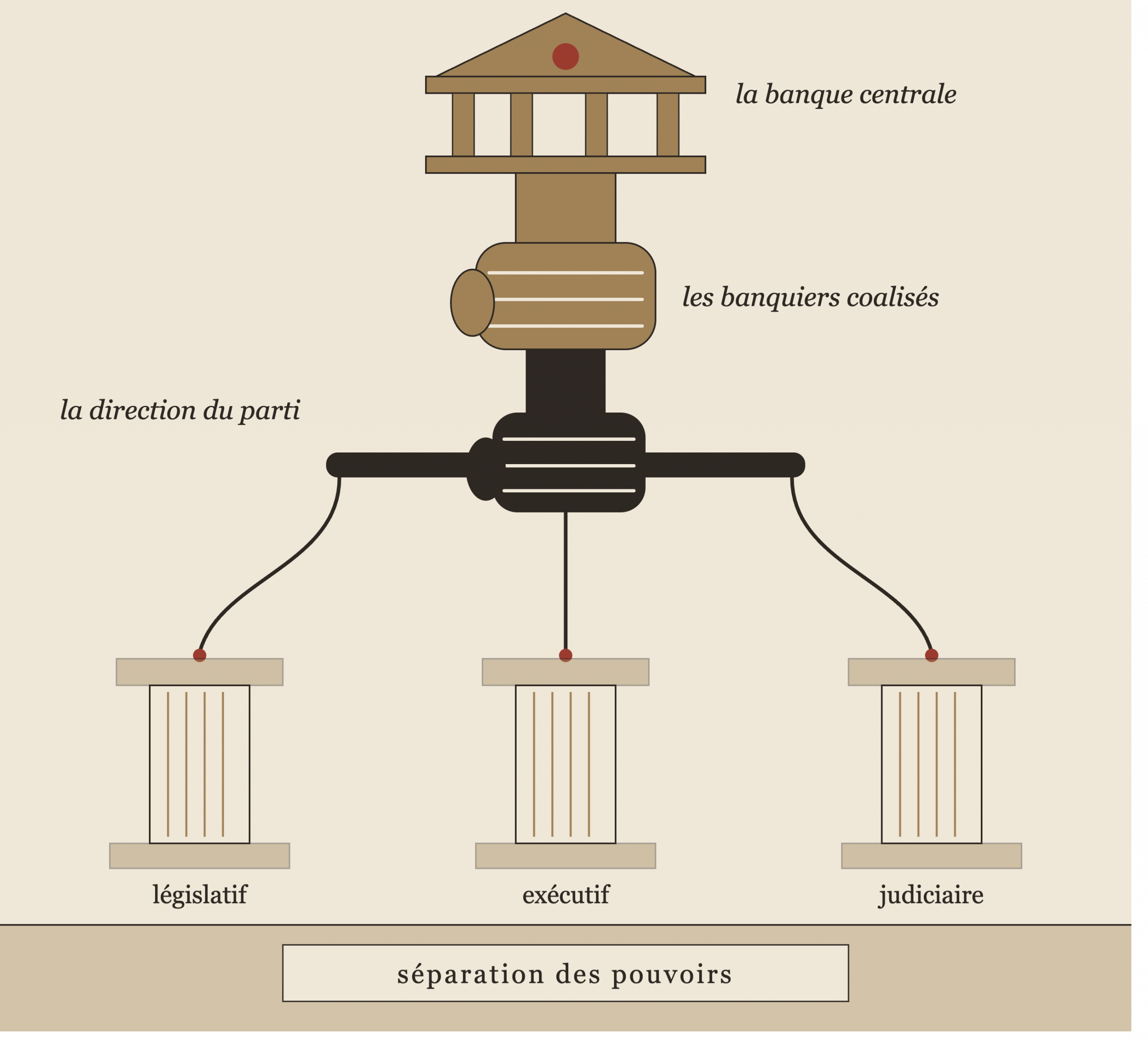
In a parliamentary regime governed by the fait majoritaire — the majoritarian fact — the three constitutional powers are not exercised by three distinct instances. They are exercised, in the last analysis, by the same persons: the leaders of the victorious party or parties.
The legislative power. Deputies do not write the law. Party directorates select the candidates, distribute the nominations and impose voting discipline. The parliamentarian who departs from it loses his group, then his nomination, then his seat. He votes what his staff instructs him to vote. This is not a pathology of the system: it is its nominal functioning.
The executive power. It is held by the same partisan personalities — whether they direct the government themselves, or control it through the apparatuses that carried it to power. The continuity between party leadership and governmental leadership is, in fact, all but total.
The judicial power. Here constitutional rhetoric is at its most deceptive. The Minister of Justice, under whose authority the organisation of the magistracy falls, is an irreducible component of the executive: he sits in the government; he is appointed and revocable by the head of government; he belongs to the victorious party. The Minister of the Interior, under whose authority the judicial police who conduct criminal investigations fall, is an irreducible component of the executive. To this must be added the executive’s appointment of the highest magistrates, its control over promotions and postings, its conditioning of careers, and its implicit sanction of magistrates deemed disloyal. The function of judging is not, within this apparatus, a separated power: it is a department of the executive.
We rediscover here the inversion announced at the outset of this study. The only power Montesquieu wished to see separated is precisely the only one we have not separated.
The three powers that were to balance one another therefore converge upon a single instance. The separation of powers subsists only as a representation — and that representation is placed under the patronage of the author who had written the contrary.
VII. The Nature of the Political Party
1. A form of British origin
A proposition must here be stated which French doctrine scarcely examines: the political party, as an organised and permanent form for the conquest of power, is a British invention.
It proceeds from the culture of the clubs — closed, co-optative structures in which interests are negotiated before the House ratifies them. Whigs and Tories constituted themselves in the 1670s and 1680s; Burke gave the party its first theoretical definition in 1770; the Carlton Club (1832) and the Reform Club (1836) furnished the two camps with their electoral machinery, contemporaneous with the Reform Act.
This form is foreign to the French political tradition, which is consistently hostile to “factions” and to the “spirit of party” — a hostility found in Rousseau, in his condemnation of partial associations, as much as in revolutionary rhetoric itself. It will be objected, and rightly, that the clubs of 1789 (Jacobins, Feuillants, Cordeliers) are French; but they are precisely an importation of English political sociability, and the Constituents denounced them at the very time they frequented them.
2. What parties produce
Partisan suffrage rests upon an electoral discourse whose status everyone knows: promises no one believes tenable, slogans reduced to their essentials, composite programmes in which the citizen globally approves dozens of measures without having chosen any of them. This discourse is sustained by an organised social division — left against right, young against old, rural against urban — and by a systematic ideologisation of debate, which substitutes for the confrontation of real interests the clash of abstract banners.
Parties are not conceived to represent real interests. Real interests are multiple, contradictory and anchored in determinate activities; they do not lend themselves to reduction under a banner. The function of the party is to federate opinions around prefabricated labels — and, in so doing, to divide the social body into antagonistic groups.
There follows the ruin of the very notion of the general interest, which on the contrary presupposes the patient search for a common good superior to divisions.
Partisan life is therefore not the expression of democratic life. It is its organised prevention.
VIII. Genealogy: The Historical Function of the British Model
1. Parliament
The parliamentary regime is not a democracy that has drifted. It is, in its historical origin, a plutocratic apparatus which never had as its object the founding of a democracy.
Its birth certificate is dated: 15 June 1215, at Runnymede. The Magna Carta, by which the great landed proprietors obtained from John Lackland the recognition of their right to be consulted. The Great Council then instituted — which the British Parliament acknowledges in its own official sources as its origin — is an assembly of barons. Its object is not to represent the people: it is to limit royal power for the benefit of the barons. The American National Archives recall as much: the majority of the English population would remain without an active voice in government for another seven centuries.
The architecture was enlarged — to the counties, to the boroughs, to two chambers with the Model Parliament of 1295, then by gradual extensions of the suffrage — but its structural function has not varied: to validate and institutionalise the power of the great fortunes — landed, then mercantile, then industrial, then financial — against sovereign pretensions, royal at first, popular thereafter.
2. The central bank
The second institution proceeds from the same workshop and the same logic.
The Bank of England was founded by royal charter on 27 July 1694, under William III, on the proposal of the Scottish merchant-financier William Paterson. Its mechanism must be described exactly, for it constitutes the heart of the system.
It is a private joint-stock company. Its capital — £1,200,000, subscribed in twelve days by private shareholders — was lent in its entirety to the State, at 8 per cent annual interest, in return for the right to conduct banking and to issue notes. The bank’s capital therefore is the State’s debt. The subscribers did not divest themselves of their stake: they converted it into a perpetual claim, the interest on which would be discharged by taxation.
The public debt is born there — and it is born as a private annuity.
The monopoly was built in stages: the prohibition, in 1708, of any other joint-stock bank in England; the progressive extension of the note-issuing privilege; and finally, by the Bank Charter Act of 1844, the monopoly of note issue. There was no coup de force, but a century and a half of methodical consolidation.
The central bank is therefore not, in its origin, an emanation of the State. It is a private institution — and would remain so until its nationalisation in 1946 — to which the State delegated, fragment by fragment, a fundamental regalian prerogative: the coining of money. Anglo-Saxon financial historians themselves designate it as the Mother of Central Banks. All the others proceed from it: the Bank of France in 1800, the Federal Reserve System in 1913, the European Central Bank in 1998.
3. The doctrine of independence
The doctrine of central bank “independence,” presented today as a technical self-evidence, is the direct institutionalisation of this genealogy.
The central bank is independent of political power. It is in no way independent of the private economic power that conceived it, that orients its decisions, and that draws from it the primary benefit. This independence is not a democratic guarantee: it is the withdrawal of monetary creation from popular sovereignty.
Two institutions, a single project, a single origin: Parliament to hold the political, the central bank to hold the currency. France imported both — the second as early as 1800, the first in 1814.
PART THREE — THE DOCTRINAL IMPORTATION
IX. Hybridisation: An Apparatus Without an End
It would be inaccurate to describe the contemporary French regime as a mere copy of the British model. It is something else, and worse: a hybridisation.
1. The two inheritances
France received from her own history a perfectly identifiable political tradition: that of centralisation. Elaborated by the Capetian monarchy, systematised by the royal legists, taken up by the Napoleonic administration, it constitutes the most constant trait of French political economy. Therein the State is unifying; it holds the parts by the whole; it codifies, it orders, it arbitrates.
This centralisation was not in itself vicious, and it matters to say why. It was ordered to an end that exceeded it: the general interest and the common good. The sovereign was not deemed the proprietor of his power; he held it in trust, in the service of a good he had not created and could not redefine. The unity of the State was therein the guarantee of the whole against the appetite of the parts — that is, the exact contrary of a machine for capture.
France received from elsewhere, and by the routes reconstituted above, a second tradition: that of British parliamentarism. A regime without a superior norm, founded upon the fusion of powers, operated by the party, secured upon the central bank, and conceived from the outset to validate the power of the great fortunes.
2. What their combination produces
Of these two inheritances, France retained, from each, what was most dangerous — and lost, from each, what was tempering.
From the British model, she took the real concentration of powers in the hands of party directorates, without taking the counterweights that, in their own order, partially tempered it: the antiquity of a common law that the judge keeps alive against power; the vitality of local government; the institution of the jury; a political culture of organised opposition.
From the French tradition, she preserved the centralising apparatus in all its power — the administration, the codification, the hierarchy of norms, the capacity to constrain — but she lost the finality which alone justified it: the subordination of power to the common good.
The result may be formulated in a sentence. We possess the most concentrated instrument in Europe, and we no longer have any end to assign to it. The apparatus France had built to hold private interests in check has been handed over, intact, to those private interests themselves. Colbert in the service of the parties; the Conseil d’État in the service of majorities; French public power in the service of the English plutocratic mechanism.
It is an unprecedented harness, and it was not foreseeable: neither the English nor the French conceived such a thing. It was born of the graft.
It remains to understand how the finality could have been lost. One does not explain the disappearance of an end by institutional considerations. If the common good has ceased to be the term of political action, it is first of all because it has ceased to be thinkable.
X. The Imported Doctrine: Nominalism, Categorial Rights, Positivism
1. Nominalism and the Villeyan demonstration
The philosophy which, since Ockham, denies the reality of universals and grants existence only to individuals thereby deprives collective realities of any referent. If only individuals exist, the Nation is a fiction, the intermediate body a suspect coalition, and the common good a word without an object — at best the sum of particular goods, at worst an abuse of language.
Here Michel Villey must be given his due, for no one has established this filiation with greater rigour. In La formation de la pensée juridique moderne (1968), and then in Le droit et les droits de l’homme (1983), he reconstituted the decisive shift of Western legal science.
In the Roman and Thomistic tradition, ius is not a faculty of the individual: it is the just thing, the share that falls to each within an objective order which the jurist has the task of discovering, not of creating. Law is therein a reality external to the subject — a proportion, an apportionment — and justice consists in establishing it. The common good is not, in this perspective, the sum of particular interests: it is an object of knowledge, anterior to the wills, to which those wills are subordinate.
Villey situates the rupture in Ockham, within the Franciscan controversy over poverty, where ius ceases to be the just thing and becomes a power of the subject — a subjective right. The displacement is logically commanded by nominalism: if the objective order of things has no reality, then law has no other possible seat than the individual will. From this stock proceed Hobbes, Locke, and the entire modern construction of human rights — which Villey held, not out of conservatism but out of consistency, to be an inflation of claims without any ordering principle, hence structurally contradictory among themselves and incapable of founding an order.
This reading of Ockham has been contested: certain medievalists — Brian Tierney notably — have shown that the vocabulary of subjective right appears as early as the twelfth-century canonists, and reproach Villey with having forced the date of birth. The objection bears upon chronology, not upon structure. That the word is older than he thought changes nothing in the fact that concerns us: the systematic substitution of subjective right for objective right, as the axis of legal science, is a modern fact — and it entails the disappearance of the common good as an object of law.
A legal science that knows only subjects and their claims can no longer think the Nation, nor the intermediate body, nor the general interest. It can therefore no longer assign an end to the apparatus of State — which remains available to whatever will may seize it.
Whence this must be measured: the Le Chapelier Law is the exact juridical translation of nominalism. It does not suppress the intermediate bodies out of hostility to the trades; it suppresses them because it does not recognise them as having being. One does not abolish what exists: one observes that it does not exist. The decree of 1791 is not an act of economic policy — it is an ontological profession of faith.
2. Categorial rights, or the ersatz of the universal
The Ockhamist logic must be followed to its contemporary term, for it is there that it reaches us most directly.
Natural law is universal for a precise reason: it attaches to what man is. Human nature being one, the share that falls to each is measured by a common standard — and it is that common standard which makes justice possible, for to judge is to compare.
Now, nominalism cannot sustain the universal: for it, there are only individuals. But no political life can dispense with generality. Deprived of the universal, legal thought therefore manufactures substitutes: no longer human nature, but categories — constructed aggregates, defined from without, revisable at will.
The category is the nominalist ersatz of the universal. And categorial right is its juridical form: a right that attaches no longer to what man is, but to what he is classified as being.
The perversion may be measured by three consequences.
The disappearance of the common measure. If each category holds its rights from itself, there exists no longer any standard by which to relate competing claims. Villey established as much concerning human rights: a proliferation of subjective rights without an ordering principle produces rights structurally contradictory among themselves, which no reason can arbitrate. Categorial right is that contradiction institutionalised. What then decides is no longer justice, but the capacity of each category to secure its own recognition — that is, force, under the species of influence.
The division of the social body. Categories do not compose: they oppose. Right that distributes according to assigned class does, in the juridical order, exactly what the party does in the political order (supra, VII): it divides the people into antagonistic groups and ruins the notion of the general interest. Ideology and categorial right are two effects of a single cause, and they reinforce one another.
The grip upon language. The category being not a reality but a construction, whoever masters its definition masters the distribution of rights. It is no longer necessary to amend the law: it suffices to redefine who falls within the class. One measures what such an apparatus offers to a power that governs by division — and one understands why it is not combated.
3. What distinguishes the body from the category
An objection presents itself, and it must be answered, for it strikes at the heart of the architecture proposed below. Would the Interest Groupings (Groupements d’Intérêts) that we advocate (infra, XII) not themselves be categories?
They are not, and the distinction is one of nature, not of degree.
The category is defined by a passive attribute — by what one is, or by what one is deemed to be. It is constituted from without, by the legislator or by ideology. It fulfils no function within the whole. It owes nothing: it claims.
The body is defined by a work — by what one does. The physician is a body because he is ordered to health; the farmer, because he is ordered to subsistence; the judge, because he is ordered to justice. Each derives its consistency from the end it serves, and that end attaches it to the common good. The body is self-organising; it bears duties before it bears rights; it participates in the general interest by accomplishing its office.
In Aristotelian terms: *the body is defined by its ergon, the category by an accident.* The first is ordered to the whole; the second is ordered to nothing.
This is why the restoration of intermediate bodies is not the consecration of categorial rights — it is their remedy. Where the category fragments the people into irreconcilable claims, the body structures it into concurrent functions. Where categorial right calls for the arbitration of force, the body calls for the arbitration of justice, because between bodies there exists a common measure: the service of the whole.
4. The fluctuation of language, and ideology
The fluctuation of language. If words do not name realities but conventions, they may be redefined at will — and whoever masters the definitions masters the law. “Democracy,” “liberty,” “representation,” “separation of powers” become floating signifiers, available for any operation whatever.
It must be seen that the imposture reconstituted in this article is possible only within a nominalist regime of language: one steals a name only where names no longer hold to things.
Ideology. Where there is no longer a common good to seek, there remain only abstract banners to oppose. Ideology is the political form of nominalism: it offers the social body, in lieu of a shared end, labels around which to divide. One recognises here the very function of the party: the party is the organ of ideology, as ideology is the surrogate of the common good.
5. Legal positivism — and its foreign origin
Positivism completes the machine, and it is its logical term. Villey had seen it: once law is no longer the just thing but the expression of a will, it remains only to ask whose will it is. God’s, in Ockham; the sovereign’s, in Hobbes; the legislator’s, in Kelsen. Positivism is not a doctrine adverse to nominalism: it is its deferred consequence.
If the law is valid because it is posited, and not because it is just, then no norm exists above the will of the legislator — that is, under the majoritarian fact, above the will of the victorious party. The Constitution itself is no more than one text among others, revisable by the very power it claims to limit.
Now — and this point completes the demonstration as a whole — the philosophy that emptied French law of its finality is itself, likewise, an importation. Modern legal positivism proceeds from two stocks, neither of which is French.
The English stock. Bentham, who holds natural rights to be nonsense; then John Austin, who defines, in The Province of Jurisprudence Determined (1832), law as the command of the sovereign backed by a sanction. Law is there no longer the just thing: it is an order that constrains. The convergence with the regime described above is manifest — in both cases, nothing above the will that posits.
The Germanic stock. The school of Isolierung — Carl Friedrich von Gerber, Paul Laband, Georg Jellinek — whose programme is explicit: to isolate positive law from every extra-juridical consideration, that is, to emancipate it from the question of the just. It culminates in the Pure Theory of Law of Hans Kelsen, an Austrian jurist of the Vienna school.
These doctrines did not reach France by spontaneous generation. The vector may be named: Raymond Carré de Malberg, who acclimatised in French public law the method of the German publicists — that of Laband, holder of the chair at the Imperial University of Strasbourg, to whom Carré de Malberg succeeded. His Contribution à la théorie générale de l’État (1920-1922) takes up from Jellinek the decisive thesis: there exists no law anterior to the State.
This proposition deserves to be weighed. It signifies that no norm precedes the power that posits it; that the just is not an object of knowledge but a product of the will; and hence that the people has nothing to oppose to the apparatus save another act of will. It is the pure and simple negation of natural law — and it is the doctrinal foundation of the whole of our legal education.
Equity commands a precision: Carré de Malberg was not a theorist of parliamentary omnipotence, and he himself criticised the légicentrisme of the Third Republic in La loi, expression de la volonté générale (1931). He is designated here as the vector of a method, not as the author of a design.
History, finally, affords an irony which honesty requires us to note: Eisenmann’s demonstration, which ruins the Montesquieu myth and with which the present article opens, appeared in the *Mélanges Carré de Malberg* — the volume of homage to the jurist who had imported Germanic positivism into France. Eisenmann was, moreover, Kelsen’s French translator.
6. The impasse
The picture is thereby complete. France imported:
— her institutions from England — parliamentarism, the party, the central bank;
— her philosophy of law from England and Germany — utilitarianism, positivism, the isolation of positive law;
— and she grafted both onto the one element properly her own: her centralising apparatus.
Nothing remains French, in the system under which we live, but the instrument. The end, the institutions and the doctrine have come from elsewhere.
Such is the impasse into which a France of a thousand years has strayed. She today holds for her own possession institutions she had explicitly refused in September 1789 and which she received against her will. She believes she is defending her inheritance when she defends what dispossessed her. And she has adopted the philosophy that forbids her to name what is happening to her: a thought for which collective realities do not exist, words do not hold to things, ends are reduced to opinions, and law is reduced to the force that posits it.
There is no technical exit from an impasse of this nature. No institutional reform restores a lost finality. The exit is a renunciation, and it is twofold: to renounce the foreign institutions; and to renounce, more profoundly, the philosophy that made them thinkable — nominalism, the fluctuation of language, ideology, and the positivism that forms their train.
Only at this price does the common good become again an object of knowledge — and therefore of politics.
PART FOUR — PROPOSITION
XI. The Principle: Equilibrium Through Micro-Disequilibria
It is not a question of reform. One does not perfect a mechanism that functions in conformity with its design, and one does not expect those whom the system has raised to power to dismantle it.
It is a question of returning to the principle Montesquieu actually formulated: equilibrium.
True equilibrium is not decreed from above. It results from an interior balance of forces, perpetual and evolving. At the scale of the Nation, macro-equilibrium is obtained by guaranteeing the maximum of micro-disequilibria: so long as there subsist, among the forces in presence, tensions never quite resolved, every categorial interest remains politically taken into account, and no group can monopolise power to the detriment of the others.
The present system proceeds inversely: it freezes a balance of forces to the benefit of the strongest, and names “equilibrium” that stabilised disequilibrium. What is required, on the contrary, is to make the multiplicity of frictions the very guarantee of the liberty of all. Tocqueville had glimpsed it: it is not proclaimed constitutional equilibria, but the density of real counter-powers, innumerable and entangled, that forbids tyranny.
This principle commands four displacements.
XII. The Four Displacements
1. To repair and to actualise the Le Chapelier Law
To render to the social body the intermediate bodies taken from it in 1791 — not captive relays, but national Interest Groupings constituted by type of human activity: medicine, agriculture, teaching, craft, industry, research, justice, culture, spirituality. Each self-organising, defining its own rules, electing its own representatives, without tutelage or external funding liable to compromise it.
Horizontally, Citizens’ Collectives at the scale of the commune. Each citizen thus finds himself doubly represented: as the inhabitant of a place, and as the actor of an activity.
The principle may be formulated thus: no popular interest can be politically represented if it is not self-organised.
2. To impose the imperative mandate — or to renounce the word “mandate”
We must here proceed by definition, for the question is not one of political opportunity: it is one of juridical logic.
A mandate, by its nature, can only be imperative. The expression “imperative mandate” is, strictly speaking, a pleonasm — and the expression “free representative mandate,” a contradiction in terms.
What a mandate is. French civil law states it without ambiguity. Under Article 1984 of the Civil Code, a mandate is the act by which one person gives another the power to do something for the principal and in his name. From this definition follow three traits, none of them accessory:
1. The limit. The agent may do nothing beyond what is contained in his mandate (Art. 1989). A power without bounds is not a mandate: it is a transfer.
2. The rendering of accounts. The agent is bound to render account of his management (Art. 1993). A power without accounts is not a mandate: it is a donation.
3. Revocability. The principal may revoke his procuration whenever he sees fit (Art. 2004). An irrevocable power is not a mandate: it is an alienation.
Remove these three traits, and nothing remains of the concept. The word subsists; the thing has vanished.
What the “representative mandate” is. This is precisely the operation to which French political representation has been subjected. The elected official receives no instruction: he represents the entire Nation and not his electors. He renders no juridically exigible account: the ballot is not a rendering of accounts, it is a renewal, and it occurs five years later. He is not revocable: no one may put an end to his power before term.
And the Constitution of 4 October 1958 pushes the logic to its term, in its Article 27: “Any imperative mandate is null.”
This provision must be read for what it is. It does not restrict the mandate: it annuls the sole element that would make it a mandate. What the Constitution strikes with nullity is the very definition of the word it employs.
The right word. A power given without instruction, without accounts to render and without possible revocation, to a third party who will exercise it as he sees fit for five years, bears a name in law — and that name is not “mandate.”
It is a signature in blank.
The formula is in no way a metaphor. A signature in blank is the signature affixed to a writing which the signatory leaves to another the care of completing. That is exactly what the citizen deposits in the ballot box: a signature at the foot of a blank page, which the directorate of the victorious party will thereafter fill in as it pleases.
Let us then renounce the word, or restore the thing. We cannot keep both.
Why the imperative mandate was abolished. The abolition is neither an accident nor an oversight, and its date is significant: the deputies to the Estates-General were bearers of imperative mandates, settled by their bailiwicks in the cahiers de doléances — such was the French tradition. They released themselves from it in July 1789, and Sieyès furnished the justification in September: the deputy, he maintained, owes nothing to the counsels of his direct constituents, but everything to the national will.
Now this reasoning presupposes a premiss that must be made explicit: for it to hold, the Nation must have no existence outside the organ that represents it. If the Nation existed by herself, she could will, and she would have to be consulted. If she exists only through her representative, then the representative is free — for there is nothing above him against which to confront him.
This is exactly the thesis that Germanic positivism would carry to its completion: Laband identifying the German people with the sole organ that represents it; Jellinek and Carré de Malberg maintaining that there exists no law anterior to the State (supra, X-5).
The free representative mandate is therefore nominalism applied to representation. It presupposes that the people is not a reality but a fiction, of which the representative is the sole organ of expression — hence the sole judge. We recover the structure set out above: where the universal is denied, the organ substitutes itself for that which it was to serve.
What must be restored. To restore the imperative mandate is not to innovate: it is to return to the only coherent acceptation of the word. It presupposes the three traits of the civil mandate: instructions that may be opposed to the representative, issuing from the self-organised bodies and the citizens’ collectives; a periodic and juridically sanctioned rendering of accounts; and an effective revocability in the course of the mandate.
Political responsibility then becomes again what it ought never to have ceased to be: to render account, and to be liable to removal.
3. To restore Justice to its rightful place: the heart of the State, and its legitimacy
This is the most profound displacement, and the one that commands the others.
There is no possible justice without the prior existence of just laws. An independent magistracy applying unjust laws is not a guarantee: it is an instrument. The question of justice therefore does not begin at the jurisdiction; it begins at the law.
This presupposes restoring to the legists their natural role: the conservation of natural law. One recognises here the function Villey assigned to the jurist — not to produce the rule, but to discover the just thing within an order that precedes him. And it presupposes the restoration of a corps of theorists of law, charged with enacting just laws according to the Thomistic concepts actualised by the R-Évoludroit project. Their foundations will be set out in Cahier no. 2 of the Cahiers R-Évoludroit, devoted to natural law, forthcoming.
As for the function of rendering justice, it can no longer remain a department of the executive. It must be deployed at every storey of the State:
— a delegated justice, entrusted to the Interest Groupings for the technical disputes of their sector, following conciliation;
— a retained justice, exercised by the central jurisdictions, guarantors of the unity of interpretation of the common law;
— a Court of Equity, attached directly to the Head of State, for cases in which a condemned person finds himself — despite the correctness of the law and of its application — the victim of a grave injustice; its judgments never constituting precedent, so that each case may be judged for itself.
4. To restore monetary sovereignty
Without it, all the rest remains decorative. To coin money is a regalian prerogative: it is not delegated.
5. The role of the Head of State
Within this architecture, the Head of State is not a decision-maker. He is the arbiter, charged with keeping the friction alive, seeing to it that no interest durably gains the upper hand.
Conclusion: Restoring Montesquieu to Montesquieu
Let us take up again the three propositions announced.
The separation of powers is not Montesquieu’s. It is a subsequent doctrinal construction, established as such since 1933, and one that contradicts the very text from which it claims descent. What Montesquieu prescribed was that the powers should move in concert while thwarting one another — and that justice alone should be held apart. We have done the inverse, exactly.
The regime is not French. It is British, imported between 1814 and 1830 by bankers, ratified out of habit in 1875, and it rests upon the fusion of powers — which English doctrine has written down in black and white since 1867, eight years before we adopted it.
Nor is the doctrine French. Nominalism comes from Ockham; utilitarianism and law-as-command, from England; positivism, from Germany and Vienna. We grafted them onto the one good that was ours — the centralising apparatus — of which we have kept the power while losing the end.
Nothing remains French, in the system under which we live, but the instrument.
Such is the mark of successful operations of influence: the target does not know itself taken. The French, who believed they had refused England in September 1789, have lived for two centuries under an English regime, thought according to Anglo-Germanic categories, reciting the name of a philosopher who had written the contrary — and believing, in so doing, that they were defending their inheritance.
Partisan parliamentarism is therefore not an imperfect democracy. It is a plutocratic apparatus that functions well: it concentrates the powers, it divides the social body, it withdraws the currency from sovereignty, and it accomplishes all of this under a borrowed French name.
What we propose is therefore not a rupture with Montesquieu, but a return to what he wrote — against two centuries of reading that have betrayed him. He never asked that the powers be separated into three watertight compartments, an apparatus which experience establishes separates nothing. He asked that power check power.
That is an altogether different requirement. It is considerably more difficult. And it has never, in France, been attempted.
Sources and References
Texts
— Montesquieu, De l’esprit des lois, 1748, Book XI, chapters IV and VI.
— Declaration of the Rights of Man and of the Citizen, 26 August 1789, Article 16.
— Le Chapelier Law, 14 June 1791.
— Constitutional Charter of 4 June 1814; revised Charter of 14 August 1830; electoral law of 19 April 1831.
— French Civil Code, Articles 1984, 1989, 1993 and 2004 (on mandate).
— Constitution of 4 October 1958, Article 27.
— Constitutional Reform Act 2005 (United Kingdom); European Convention on Human Rights, Article 6.
Doctrine
— Charles Eisenmann, “L’Esprit des lois et la séparation des pouvoirs,” in Mélanges R. Carré de Malberg, Paris, Sirey, 1933, pp. 165-192.
— Louis Althusser, Montesquieu. La politique et l’histoire, Paris, PUF, 1959.
— Michel Troper, La séparation des pouvoirs et l’histoire constitutionnelle française, Paris, LGDJ, 1980.
— Walter Bagehot, The English Constitution, London, Chapman & Hall, 1867.
— Jean-Louis de Lolme, Constitution de l’Angleterre, Amsterdam, E. van Harrevelt, 1771.
— Voltaire, Lettres philosophiques, 1734.
— Jeremy Bentham, Anarchical Fallacies, 1796; John Austin, The Province of Jurisprudence Determined, London, 1832.
— C. F. von Gerber, Grundzüge eines Systems des deutschen Staatsrechts, Leipzig, 1865; Paul Laband, Das Staatsrecht des Deutschen Reiches, 1876; Georg Jellinek, Allgemeine Staatslehre, Berlin, 1900.
— Hans Kelsen, Reine Rechtslehre, Vienna, 1934.
— Raymond Carré de Malberg, Contribution à la théorie générale de l’État, Paris, Sirey, 1920-1922; La loi, expression de la volonté générale, 1931.
— Michel Villey, La formation de la pensée juridique moderne, Paris, Montchrestien, 1968 (repr. PUF, “Quadrige,” 2003); Le droit et les droits de l’homme, Paris, PUF, 1983.
— Brian Tierney, The Idea of Natural Rights, Atlanta, Scholars Press, 1997 (for the discussion of Villey’s dating).
Data
— Votes of the National Constituent Assembly of 10 and 11 September 1789: Archives parlementaires, 1st series, vol. VIII.
— British electorate of 1780: approximately 214,000 voters, fewer than 3 per cent of the population.
— French electorate: 166,583 voters in 1831; approximately 241,000 in 1846.
— Bank of England: charter of 27 July 1694; subscription of £1,200,000 at 8 per cent; monopoly of joint-stock banking (1708); Bank Charter Act (1844); nationalisation (1946).
Translator’s note. Passages from Montesquieu are rendered here in the author’s own translation. The phrase “fusion of powers” is quoted from Bagehot’s original English. The term fait majoritaire — the structural dominance of a disciplined parliamentary majority — has no exact English equivalent and is rendered as “the majoritarian fact.”
This article anticipates Cahier no. 2 of the Cahiers R-Évoludroit, “Natural Law — The Foundations of the Legitimate Human Order,” forthcoming, whose chapter VI will develop in full the institutional architecture here sketched. — revoludroit.fr