




by Valérie Bugault, December 18, 2025
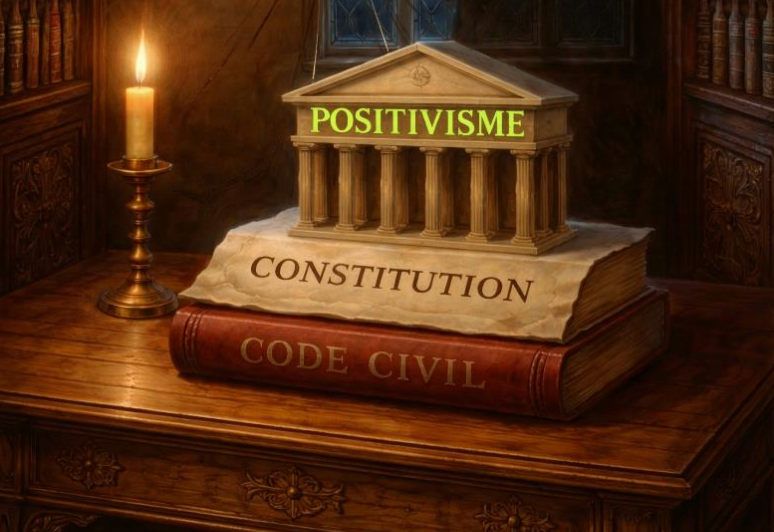
These are two fundamentally different conceptions of the hierarchy of norms that stand in opposition to one another (as I explain in my writings and videos). When it was first drafted, the Code civil reflected a hierarchy of norms grounded in overarching principles whose source lay in natural law. The Constitution, however, altered this conception from the outset—without saying so explicitly—by imposing a formal principle: a norm is superior because it emanates from the organ that society has legitimised to create the norm, the “law”. According to this logic, the hierarchy is the following: (1) the Constitution, (2) statutes enacted by Parliament (National Assembly and Senate), (3) decrees, and so forth.
These two opposing conceptions of the hierarchy of norms coexisted for a long time, generating widespread confusion. Today, and since the hegemonic rise of Hans Kelsen’s Pure Theory of Law, only the formal hierarchy of norms prevails. Thus, to the great misfortune of the French people, the Constitution now stands above the Code civil.
In reality, we collectively find ourselves confronted once again with the ambiguities of the political regime born of the 1789 Revolution, in which roughly two factions opposed one another: on one side the Montagnards, and on the other the Girondins—each grouping containing, with certain nuances, both elements corrupted by British finance and honest patriots.
With the benefit of hindsight, it is clear that the victors were the Montagnards, and among them the faction corrupted by British power. The ambiguity of the post-Revolutionary regime was embodied juridically by the simultaneous emergence of two philosophically contradictory elements: (1) the Code civil of 1804, shaped by the Napoleonic regime, and (2) parliamentarism.
The Code civil was drafted—whatever may be said—by eminent jurists steeped in the great principles of law, who viewed legal rules primarily in terms of their finality. Parliamentarism, by contrast, imposed de facto a formal hierarchy of norms in which the legislator concerns himself solely with the means established by rules, while the finality of law is effectively handed over to anonymous financial powers operating through political parties (as I explain in my work).
The Code civil of 1804 is the product of the long French legal tradition built upon codification and upon a hierarchy of norms whose highest degree is natural law. By contrast, the law that flows from parliamentarism is a purely exogenous product, imposed in France by supporters of the British Empire—whose legal order serves the Admiralty, and in which jurists are reduced to the rank of mere scribes, no longer concerned with the ends of law but only with the technical means required to serve the superior interests of stateless financial elites (needless to say).
The law generated by the parliamentary regime is structurally at the service of financiers, not the population. It corresponds to the positivist “order”—which is, in fact, a disorder. Positivism is inherently opposed to natural law and is furthermore the pure product of the nominalist doctrine.
The war of legal paradigms has therefore been lost to the British Empire, through the subversion of our continental legal model, historically based on:
- political realism (versus the nominalism of British Admiralty law),
- natural law as the foundation of the hierarchy of norms (versus the purely formal origin of the rule depending on the organ that promulgated it—unrestrained positivism),
- codification (versus the compilations characteristic of British Admiralty law).
French jurists formed within this tradition once concerned themselves with the purpose of the rule enacted, which had to conform to natural law derived from the natural order of this world.
We have collectively LOST the war of law, and we are paying the price for it.
Unless a profound shift occurs—one that amounts to a change of paradigm, as set out in the Révoludroit project—we must resign ourselves either to perish or to become eternal slaves.